 AUSSIE ROBOTS
RESPONSIBLE AUTONOMY
Move on the loop.
Stay accountable.
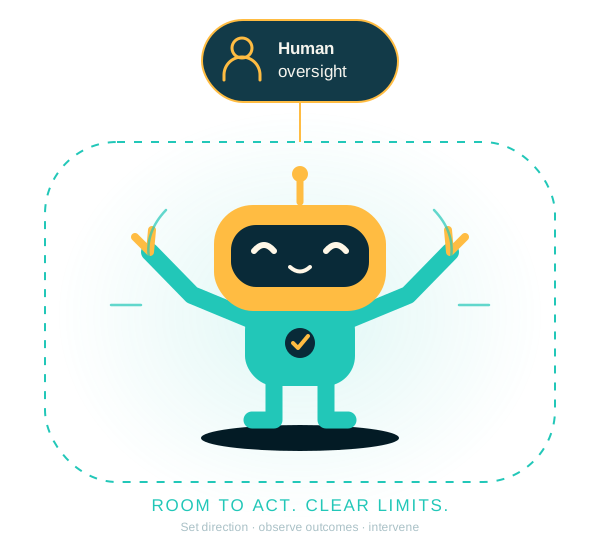
Give agents room to act within defined boundaries, while people set direction, oversee outcomes and intervene when it matters.
CAPABILITY BEFORE CONSULTING THEATRE
“Human-centric” needs
an operating model.
In his article, Nick Hortovanyi challenges AI consulting that leaves clients dependent on reports or makes human approval the default for every agent action. His emphasis is on people developing direct AI capability and agents acting within bounds, with consequential actions escalated.
Our practical response: work alongside your domain experts, build a useful workflow and make the decision boundaries visible. Judge the result by its usefulness, error patterns and outcomes—not by the label on the presentation.
Read Nick’s article on Medium ↗FROM APPROVING ACTIONS TO GOVERNING AUTONOMY
Move the human role.
Keep the authority.
The shift is from reviewing each proposed action to defining what the system may do, observing how it performs and intervening when needed.
Approval before action
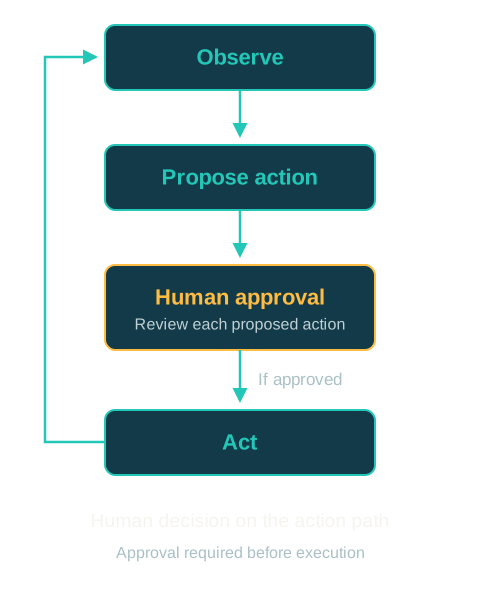
Oversight around action
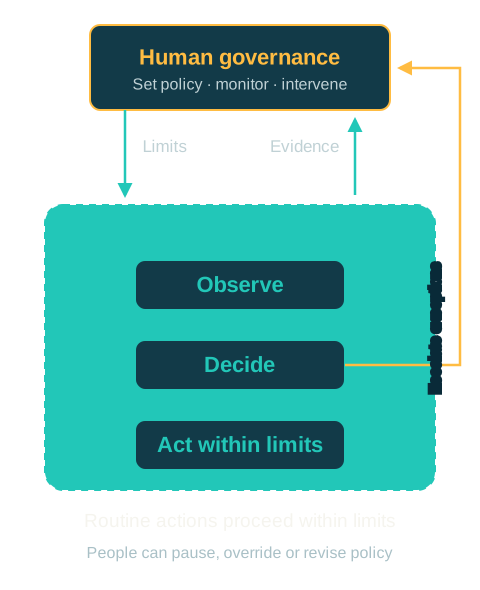
Keep explicit approval for actions that require it. Define escalation triggers and pause behaviour before delegating authority. On-the-loop governance requires timely evidence and a practical ability to intervene.
Conceptual operating models. Solid teal arrows show the routine flow; gold marks human authority and exception escalation. The dashed boundary represents delegated authority.
Map your governance boundary with us ↗A PRACTICAL STARTING POINT
Turn intent into
clear operating boundaries.
- Map the decisions
Identify who acts today, what the consequences are and which actions are reversible.
- Define authority
Specify what an agent may do, what it must escalate and who owns the outcome.
- Provide context
Give the workflow clear goals, relevant information and explicit constraints.
- Make it observable
Capture decisions, outcomes and exceptions so oversight has evidence to work with.
- Test the boundaries
Exercise failure cases, approval paths and the ability to pause or recover.
- Expand on evidence
Measure the workflow against its baseline and widen authority only when justified.
FOR CEOS, BOARDS & TECHNOLOGY LEADERS
Commanding Autonomy
A 90-minute executive briefing or strategy session on oversight in the age of AI.
Explore a candidate workflow, its decision boundaries, accountability and escalation paths. Use the discussion to identify priorities for a bounded pilot and the evidence needed to evaluate it.
Enquire about a briefing ↗LET’S BUILD SOMETHING USEFUL